


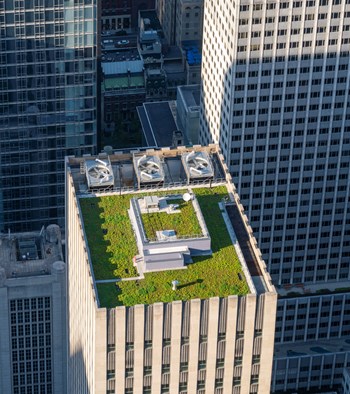
The Windy City has hundreds of green roofs covering millions of square feet. While Chicago doesn’t have a law mandating green roof conversions by a specific deadline, it does have policies encouraging both existing and new construction to install greener roofs. The city uses a mix of building-code requirements, incentive programs, and planning policies that effectively push most new or renovated roofs to go cool, green, or solar-ready. Here’s an overview:
Be Cool
Chicago’s building code has included a cool roof requirement since the early 2000s. Low-slope roofs, whether on new construction or existing buildings, must meet high solar reflectance standards. In practice, this means that when a roof is replaced, the new one must be vegetated or have a white or reflective membrane, rather than a traditional dark covering like asphalt or tar. In certain districts, developers can receive a Floor Area Ratio (FAR) bonus for ‘greening’ at least 50% of a project’s roof, enabling them to build more square footage than what an area’s official zoning might otherwise permit.
Under Chicago’s Sustainable Development Policy, development projects must choose from a menu of sustainability strategies, which can include green roofs, stormwater management, and other environmental measures. The 2022 Chicago Energy Transformation Code added requirements, such as solar-ready roof zones for many buildings under 60 ft tall. Also, certain developments must include green infrastructure elements if they receive city financial assistance, zoning changes, or planned development approval. Over time, this effectively transforms the roof stock gradually, as buildings undergo normal roof replacement cycles.
Why Chicago Leaned in on Solar
Tragedy sometimes inspires policy, and according to the EPA, Chicago’s push for heat-mitigation strategies like green infrastructure came largely after the 1995 heat wave that caused hundreds of deaths and prompted the city to act.
Cool roofs and vegetated roofs help reduce the urban heat island effect and reduce AC demand citywide, lessening stress on the grid and making brown- and blackouts less likely. In fact, some data modeling suggests that if Chicago replaced all of its conventional roofs with white, green, or solar roofs, citywide energy use could drop more than 16% and temperatures could fall 2° C during heat waves.






Leave a Comment