


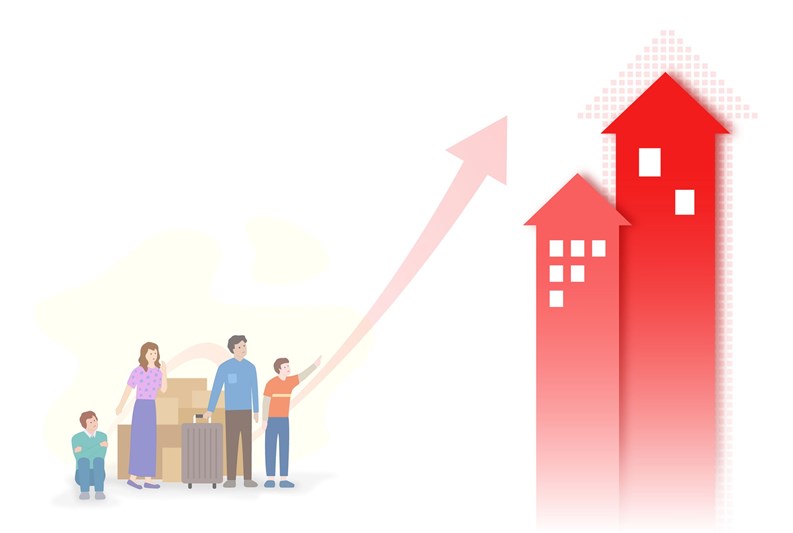
The housing affordability crisis isn’t exactly breaking news; over the past 25 years, stagnant wages and spiralling prices for even modest one- or two-bedroom condo units have raised the bar to homeownership well beyond the reach of most first-time and middle-income buyers.
For a local example, since 2000, the West Town/Near West Side and Logan Square/Irving Park neighborhoods have seen some of Chicago’s most dramatic price increases for residential condos. According to the Cook County House Price Index, prices in these submarkets have more than doubled, and even tripled, in that time—a gain of over 250% in some cases.
West Town / Near West Side
Since 2000, the West Town/Near West Side area has seen condo and overall housing prices climb by around 253%. This increase reflects intense demand among professionals seeking proximity to downtown, and has led to the renovation of historic buildings and an influx of new amenities catering to this demographic.
Logan Square / Irving Park
Logan Square and its surrounding neighborhoods have seen similar dramatic increases—prices here are roughly 262% higher than in 2000, according to the Cook County House Price Index.
In real numbers, that means current condo listings often show median prices well into the $600,000 - $800,000 range for popular portions of Logan Square, compared with much lower benchmarks in the early 2000s, where according to Realtor.com, many smaller 2‑bedroom units could be found in the low to mid‑$200,000s.
Bridgeport / Lower West Side
Another neighborhood experiencing 250+% increases; prices in both these submarkets have risen 252% since 2000, largely due to spillover from redevelopment in the West Loop and Near West Side, as well as new retail and transit improvements.
Some Hard Numbers
According to data from Homes.com and Realtor.com, one‑bedroom units in the West Town/Logan Square area are typically priced around $350,000 – $500,000; two‑bedroom units often ask between $550,000 – $800,000. Prices for larger units commonly range from $750,000 to $1 million+, depending on specific street, building quality, and finishes — with some luxury or larger units above that axis in Near West Side developments.
By contrast, two or three decades ago, these areas had very different pricing norms. In the early 2000s, one‑bedroom condos in much of West Town or Logan Square could often be found in the mid‑$100,000 to low‑$200,000 range, with two‑bedroom units often under $300,000, and three‑bedrooms frequently under $350,000. According to Realtor.com, this means in many segments there has been at least 100–200% appreciation in nominal dollars—and even more in inflation‑adjusted terms—over 20+ years relative to historic pricing.
Why So High?
Several factors explain this dramatic long‑term appreciation:
West Town and Logan Square were once industrial, working‑class neighborhoods. Over the last two decades, they have undergone extensive revitalization with renovated housing stock, new retail, restaurants, and cultural amenities. This attracted young professionals and families, boosting demand.
Proximity to downtown is another factor. Both neighborhoods are walkable to the Loop, or easily reached via public transit. As remote work trends eased, people continued to value transit access and shorter commutes. This stronger demand, combined with Chicago’s relatively low supply of new condo construction since the 2008 recession, has put upward pressure on pricing.
Impact on Longtime Residents & Newcomers
For homeowners who bought early in the gentrification wave, these precipitous price increases have often translated into significant wealth appreciation, allowing many to refinance, sell at a substantial capital gain, or build equity. According to Realtor.com, in some cases, condos purchased for under $200,000 in the early 2000s are now worth $500,000-$800,000+, especially for well‑located two‑bedroom units. Owners with long holding periods benefited from both market growth and demographic shifts.
As condo prices have risen, many long‑term renters in these neighborhoods have been hit with rent increases or conversion of their buildings to condos—a factor that contributes to displacement pressures, and a central theme in discussions about equitable development in Chicago’s hot markets.
According to the Cook County House Price Index, longtime homeowners in districts like West Town and Logan Square have generally benefited from some of the most dramatic condo price growth in Chicago over the last 25 years, while newcomers face increasingly high barriers to entry—a dichotomy that’s reshaping both the social and economic fabric of these communities over time.



Leave a Comment